


St Matthews Church, designed by Alex. Johnston, was built on Broughty Ferry Road and opened for worship on 3rd October 1875.
It was described as “80 feet long and 46 feet 3 inches wide. The height of the roof to tie beam is 27 feet 6 inches, and to apex 43 feet. The side elevations will have three-light windows for area, and two-light for galleries. The west front has a three-light window, with small side windows, and the east gable is lit by a wheel window with windows on each side. Entrance is got through a tower at the south-west corner, which rises to a height of eighty-five feet, with corbelled parapet and slated roofs. Entrance is also got through a porch at the north-west corner. At the west end of the church, and inside the same, an open staircase leads to galleries, entrance being got from both porches. The galleries are carried on iron pillars, and only extend the length of transepts. A classroom, vestry, and heating place are provided at the east end of the church, the accommodation will be for 860 persons, the seats being of the most improved construction, with open bench ends.”
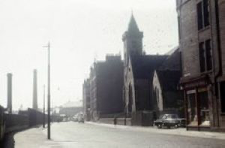
In 1884 St Matthews was seeking to be made into a parish church. In evidence to support this ambition it said it served a population in excess of 6,400, a congregation almost entirely composed of working people.
The boundaries of the proposed parish were defined as from Princes Street at its junction with Wallace Street, thence running eastward along the middle of Princes Street, Graham Place, Robertson Street, and Arbroath Road to Eastern Necropolis gate; thence southward to River Tay, line passing east end of Craigie Terrace; thence westward along the river to point opposite the foot of Peep o’ Day Lane; and thence through the middle of Wallace Street to the point where this description begins.
The church was closed for six weeks in 1901 for alterations and additions to be made. The interior was transformed from a bare and not especially cheerful interior into a “really comfortable” and “pleasingly artistic” place of worship. The walls were painted pale salmon and “treated with a judicious variety of designs and mottoes”. On an arch over the pulpit were the words in gold ‘Glory to God in the highest: 0n earth peace goodwill to men’. On the sides of pulpit were the words ‘I am the true vine’ on one side and ‘I am the Bread of Life’ on the other. In the pulpit’s central panel is the sacred monogram ‘I.H.S.’ on one side the Greek letter Alpha, and on the other Omega, the whole symbolising that Christ is the beginning, centre and end of Christian life. Various other embellishments had been made along with improvements to the heating system and the gas lighting system, the whole completed by the installation of a large organ. The classroom was also doubled in size. The cost of the improvements, some £1,000, was raised with money raised by a bazaar in 1899.
Churches always need money. In 1927 this cost was estimated at £584.12sh. This was to be met by seat rents from 662 members of the Congregation and collections of 3d per Sunday. Members were also expected to contribute to the various Church schemes at the rate of one penny per week and 1 shilling per week for the General Trustees. Members also had to sign to put their commitment in writing.
Money continued to be a crucial feature in church affairs in a spectacular way. The Minister, the Rev McColl, was declared bankrupt. His income was made up of the stipend plus an endowment. He hoped to receive between £350 and £400 per year. In his first year he received £380 and £350 in the next. By 1926 it had fallen to £250 and thereafter he was reliant on the £120 from the endowment. He had fallen into living off credit, but his income never amounted to enough. In January 1928 the Rev McColl sent in notice of his resignation only, a week later, to send a telegram saying that his notice had been sent in error. The congregation that week was twenty, more than it had been for some while. In fact, the beadle had to wipe mould off the covers of the Bibles and dust down the pews. When a week later the Rev McColl turned up to take the Sunday service the congregation numbered only nine.
Dundee Established Presbytery pressed ahead with its disciplinary case against McColl, accusing him of negligence, conducting himself in an improper manner, and insufficiency and by his “negligent, scandalous, insufficient and contumacious” behaviour he had alienated his parishioners and caused them to disrespect him. The Rev McColl found himself in even deeper water with the Church of Scotland when it was revealed that he had failed to have his appeal, which ran to between 300 and 400 pages of typescript, printed, as the rules demanded. Rev. McColl’s reason for this was that he could not afford the £150 or so that printing would cost. It was decided that a committee be appointed to decide the issue, which decided in favour of the minister. On 2nd April it was reported the Rev. McColl had accepted an offer to join his brother in the U.S.A. and take on the ministry of Wood River. The stipend was $1800 with a manse provided and $200 for removal expenses.
Meanwhile the Rev. McColl’s case continued during which it came to light that evidence that McColl had had a relationship with a woman not his wife was largely down to three gossiping women living in a tenement in South Baffin Street. Clearly the Rev. McColl had, at some stage, fallen out with the church office-bearers. The case was concluded at a hearing before the General Assembly at which, after several hours of claim and counter claim, McColl was dismissed from his post at St Matthews but retained his status as a minister.
The Rev. McColl resurfaced in Scotland in 1930 and in 1933 was elected minister of Milton Parish Church, Glasgow. In that same year the St Matthew’s congregation issued a call to the Rev Robert Kerr. Unfortunately, the call was by no means unanimous indicating that all was not well with the church, but the Clerk to the Presbytery hoped that the Rev. Kerr “would dissipate a great deal of the feeling that prevailed and by his good work gather round him the whole congregation.” The Rev Kerr soon made his mark. In 1907 the Roman Catholic Church had passed the decree of “No Temere” which stated that where there was no priest there could be no marriage, meaning that if a Catholic married a Protestant before a Protestant minister the marriage was declared invalid and any children illegitimate. Leading opposition to the enforcement of this decree the Rev. Kerr successfully moved a resolution at an interdenominational meeting in the Caird Hall condemning the enforcement of the decree to mixed marriages. In 1938 it was found necessary to hold a sale of work to raise funds for the ‘resuscitation’ of the church organ which had a disconcerting habit of suddenly coming to a dead stop. The sale raised over £100.
After the War St Matthew’s found itself with a new minister of a different colour. In 1953 the Rev James Stewart fulfilled a longstanding ambition in becoming the minister at a parish in his hometown. Coming via Baxter Park Church where his father and brother were respectively elder and deacon he had a reputation on concert platforms as a conjuror, singer, violinist and compere. He was also involved in the Dundee F.C. Supporters Club. It was no surprise then that the 350 who turned out to his induction social were treated to music from Jimmy Shand. Rev Stewart also put in an appearance at the Dundee Orphanage Christmas Party where he not only performed conjuring tricks but also showed his audience how they were done. He also entertained with his musical saw.
Around 1980 St Matthews joined with Wallacetown and Baxter Park Churches to form Trinity parish. St Matthews church building was demolished in 1982 to make way for housing.